VisionPerformance.Store

Automobiles Classic Garage
Product Purchase
Call 305 389 0928 ask for Albert
Free Shipping USA over $500.00.
AMA Optics,Inc
Instruments
Hand Made USA
Call 305 389 0928
Starts at $1000.00
Built for 21 Years, Clinically Proven to Predict post-op vision, Pre-op!
Predicts the Future
Made in USA
Apple Store Apps
(Order app)
1. Fovea Test (Macular)
Self-test Person
One Test Type (Macula)
MacHealth.pro
99 Cents/30 Tests
(Order)
2. Fovea Test (Macula)
Professional
10 Test Type
CPT code 92284
Amblyopia
Easy to use, data stored, email results. Must wear special glasses for some tests.
Get at www.amaoptics.com
Scroll
Down⬇
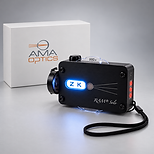
Glare Tester
Starts at $925.00
Dual Bulbs, Spot light and Flood light
Rechargeable
Call 305 389 0928




DiagnosticGame
Patent
MacHealth
Patent
MacDx
Press
Release
Waiting 100 Years for Adaptation

Tap to Watch
NEWS
For Your Eyes
Albert J. Hofeldt, MD


I am an ophthalmologist trained at the Edward S. Harkness Eye Institute of Columbia University in NYC. I have several US patents, two on iPhone devices that measure the foveal dark adaptation. It has been 100 years since the first monocular adaptation of the eye was made in 1921 by Selig Hecht, PhD. His testing was challenging and took 1.5 hours per test. No public device was made, testing was too difficult.
MacHealth.pro IOS app is downloaded to the iPhone and played for 2 to 6 minutes depending on the tests. For the first time, people have the ability to test themselves scientifically at home. At AMAOptics.com, read the published article in the Eye Journal. The test is available on MacHealth.pro app for the public and on MacDx.pro app for the Eye doctors. CPT code 92284.
The MacHealth.pro app
at the Apple Store
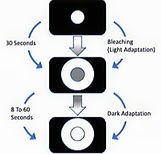
Light brightness and dimness, how do the eyes allow us to see well under different brightness? When we go into a dark theater, after a few moments the eyes adapt, and we find our seat. When we go outdoors on a sunny day, our pupils narrow, and we see better. The eyes constantly adapt throughout the day making vision better as lighting changes.
Around 1900, the ERG was invented and greatly measured the peripheral retina but not the center retina, the fovea. In fact, many scientists thought the fovea had no measurable measurement and others thought it was too fast to measure. Selig Hecht, PhD in 1921 measured a single human fovea with a red-light adaptometer. In 1953 and 1989 others measured the adaptation in only one eye of people. The fovea has only cone receptors that measure color and black/white, the peripheral retina has only rod and cones that measure only black/white.
Using a different method, Albert J. Hofeldt, MD patented the adaptation of the foveal cones in two eyes, first one eye and then the other eye. He developed two computer patents to measure white light adaptation and another measuring-colored light adaptation. AMA Optics supplied the iPhones apps to the iPhones of JS Kane, M Gaspich, A Gold, H Pichardo and SA Kane, PhD. MD, their results of normal people showed it to be fast, easy, reproducible, unaffected by bright light or pupil size and recovery time increased with aging. Results of completing the testing of normal and diseased eyes have been sent for possible publishing.
Currently there is a test that measures a spot of the peripheral retinal which seems to predict the deterioration of macular degeneration at some time in the future, but since it does not measure the fovea, it will never measure foveal function.
The MacHealth and the MacDx are my apps that measure the fovea. The MacHealth IOS app is for all people to test on their iPhone. One test on both eyes takes 2 minutes, results are recorded, stored and transferable. To repeat 3 tests, take 6 minutes. People who follow their fovea, usually test the fovea every 3 months. This is the first digital test for macular problems tested at HOME on an iPhone or iPad. Online purchase of 30 tests for 99 cents, which is 3.3 cents per bilateral test. For now, we take calls to help with learning the test, call 305 389 0928, ask for Albert.
Take a Photo & Order MacHealth app

Computer Symbols
Endpoint
Computer Symbols